


In coal handling plants, mines, quarries, and bulk-material terminals, efficient screening is not simply about separating large particles from small ones. It is about protecting crushers, stabilizing downstream flow, reducing unwanted fines, and keeping production moving when the feed is wet, sticky, mixed, or difficult to screen.
This is where a roller screen earns its place.
A roller screen is a continuous screening machine that uses a series of parallel rotating shafts fitted with discs, rollers, or specially shaped screen elements. As material travels across the rotating surface, undersize particles pass through the controlled gaps between the rolls, while oversize material is conveyed forward to a crusher, conveyor, or another processing stage.
Unlike a traditional vibrating screen, a roller screen does not rely on high-frequency vibration to separate material. Its screening action comes from controlled rolling, lifting, agitation, and forward transport. That combination makes it especially effective for raw coal, lignite, clay-bearing ore, overburden, coke, limestone, construction aggregates, and other bulk materials that may clog conventional screen media.
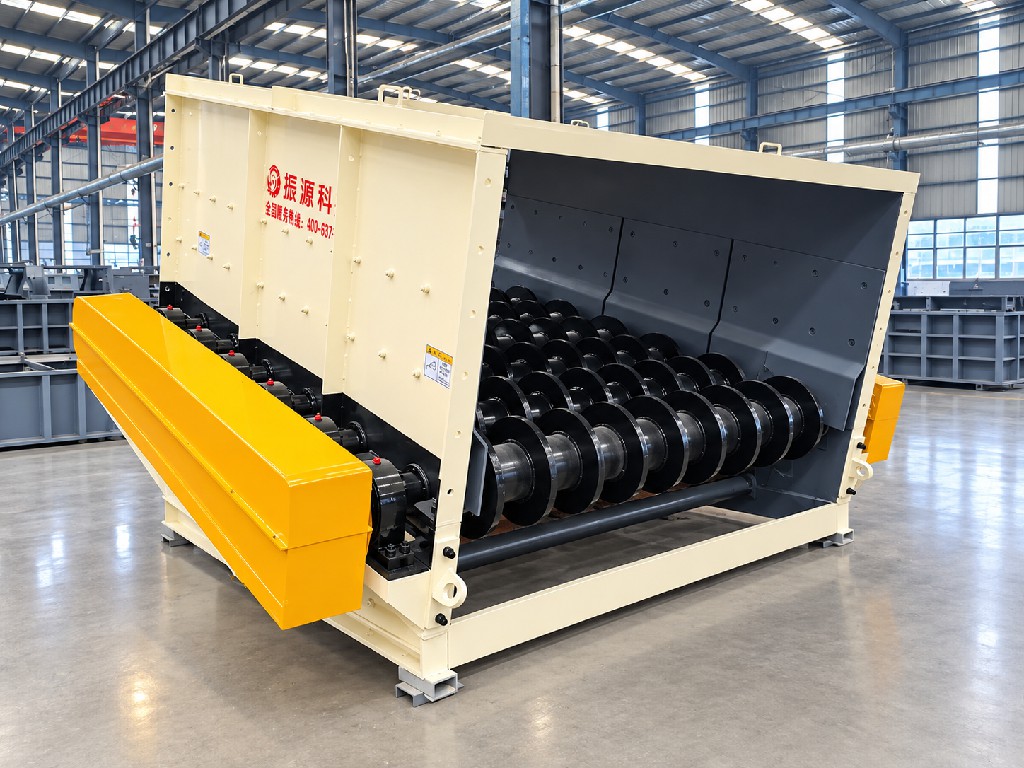
The working principle of a roller screen is straightforward: material enters at the feed end and travels over multiple rotating screen shafts. Each shaft is equipped with discs or shaped rollers, and the spacing between these components creates the screen aperture.
All rollers typically rotate in the same direction. Their shaped surfaces repeatedly lift, turn, loosen, and move the material toward the discharge end. Smaller particles find openings between the rollers and fall through to the undersize chute or conveyor below. Larger pieces remain on top of the roller screen and continue forward.
The screen does more than classify material by size. Its rolling motion helps break up loose agglomerations, exposes fine material trapped beneath larger lumps, and reduces the chance of material bridging across the screening surface. The result is a more even feed to the next machine.
The actual separation point depends on the disc profile, spacer arrangement, shaft pitch, rotational speed, feed distribution, and material characteristics. A nominal gap is important, but it is not the only factor. Particle shape, moisture, clay content, and the percentage of near-size material can all influence screening performance.
The process begins when run-of-mine coal, crushed ore, or other bulk material drops onto the feed end of the roller screen. A properly designed feed chute is essential. It should spread material across the full width of the screening deck instead of allowing it to land in one narrow stream.
An overloaded or poorly distributed feed can reduce screening efficiency because the top layer shields fine particles from the openings below. Even distribution gives the material more opportunities to contact the gaps between rollers.
As the shafts rotate, the discs or roller elements grip and lift the material. Because many roller screens use eccentric, triangular, elliptical, or specially profiled discs, the material does not simply slide across a flat surface. It is gently rolled, turned, and advanced.
This agitation is particularly valuable for sticky coal or clay-coated rock. Instead of allowing damp material to sit on a stationary screen surface, the rotating elements keep it moving and expose more particles to the screening apertures.
Particles smaller than the effective screen opening pass through the spaces between adjacent rollers. These fines are collected in a hopper, chute, or belt conveyor beneath the machine.
The repeated lifting action gives fine particles several chances to pass through. A particle that does not fall through near the feed end may separate farther along the screening deck after the material bed has been loosened and rearranged.
Material larger than the selected aperture remains on top of the rotating shafts. The roller screen carries it forward in a steady, controlled flow until it reaches the oversize discharge.
In a coal crushing plant, this oversize fraction often goes directly to a crusher. By removing fine coal before crushing, the roller screen reduces unnecessary crushing work, lowers wear, and helps prevent excessive generation of fines. In mining applications, it may also act as a scalping screen before primary crushing or as a control screen after a crushing stage.
A reliable industrial roller screen is built around a few core systems:
The exact arrangement differs by manufacturer and application. Some roller screens use replaceable wear segments, while others use full roller assemblies. High-abrasion applications may require wear-resistant alloy discs, hardened shafts, replaceable liners, and reinforced feed zones.
A roller screen is often selected when conventional vibrating screens struggle with wet, sticky, lumpy, or variable feed. Its open roller design has fewer areas where material can blind the screening surface. The constant rotation also helps dislodge loose adhesive material.
For coal, this is particularly important during rainy seasons or when handling high-moisture raw coal. Wet fines can stick to larger lumps, reducing separation efficiency on a standard vibrating deck. A coal roller screen repeatedly lifts and turns the feed, helping these fines separate without aggressive vibration.
Roller screens can also offer gentler material handling. Because the material is rolled and conveyed rather than thrown through a high-amplitude stroke, there is less impact-related degradation. This can help preserve lump coal or reduce avoidable fines in friable materials.
Choosing a mining roller screen requires more than selecting a gap size. A proper specification should consider:
For example, a screen handling wet lignite requires a different disc geometry and cleaning arrangement than one screening dry limestone. A high-capacity coal handling plant may also require a wider deck, multiple drive zones, robust anti-jam protection, and condition monitoring for critical components.
The feed rate should be matched to the available screening area. Running a roller screen above its design capacity may keep oversize moving, but it can reduce fine-particle recovery and increase wear in the feed section.
A roller screen is a dependable machine when it is operated within its design limits and inspected regularly. The most important maintenance tasks include checking roller alignment, bearing condition, gearbox oil levels, coupling wear, chain or belt tension, scraper adjustment, and structural fasteners.
Operators should also watch for uneven feed distribution, abnormal noise, sudden power increases, excessive vibration, or material buildup around the shafts. These symptoms may indicate a worn disc, blocked scraper, damaged bearing, misalignment, or oversized foreign object in the feed.
Routine cleaning is especially important when processing moist coal, clay-rich ore, or sticky overburden. Keeping the underside of the screen clear helps preserve the effective aperture and prevents the machine from losing capacity over time.
A roller screen works by combining screening and conveying in one continuous process. Rotating shafts with shaped discs create controlled openings, loosen the material bed, allow undersize particles to fall through, and move oversize material toward the next stage.
When properly selected, a roller screen can protect crushers, improve throughput, reduce clogging, and produce a more stable process flow. For coal and mining operations dealing with difficult material, it is often one of the most practical solutions for reliable pre-screening and scalping.
A roller screen can process raw coal, lignite, coke, limestone, iron ore, clay-bearing rock, overburden, aggregates, and other bulk materials. It is especially suitable for materials that are wet, sticky, lumpy, or prone to clogging conventional screen decks.
A coal roller screen uses rotating shafts and discs to roll, convey, and separate material through controlled gaps. A vibrating screen uses vibration to stratify and pass material through mesh or perforated media. Roller screens are often preferred for sticky coal and crusher-relief duties because their rotating elements help reduce blinding.
A mining roller screen aperture should be selected according to the required separation size, particle shape, feed moisture, percentage of near-size material, and downstream equipment requirements. The effective cut size is determined by the combined design of roller discs, spacers, shaft spacing, and operating conditions.
An industrial roller screen should receive regular inspections of shafts, discs, bearings, drive components, scrapers, guards, and feed chutes. Maintaining proper roller alignment, removing sticky buildup, monitoring temperature and noise, and replacing worn parts before failure will improve uptime and screening efficiency.